
Guide
Subsea power cables: how installation, protection and repair work on the seabed
A high-voltage cable on the floor of the Baltic or the North Sea is a factory product, a shipping operation and a security problem at the same time. This guide follows one from the factory reel through subsea cable laying to the repair ship.
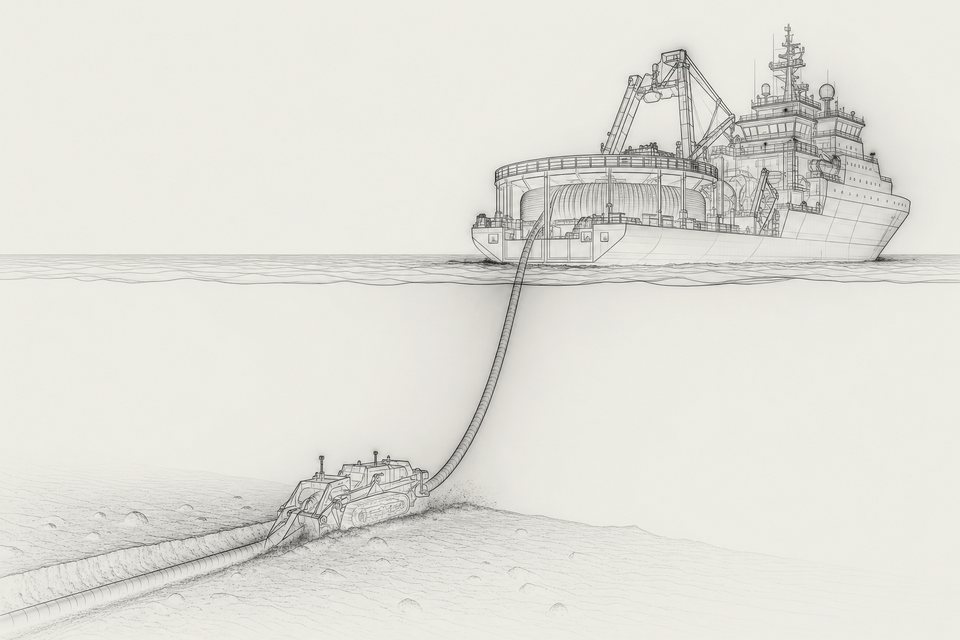
Subsea cable
From the surface to the seabed
Follow an export cable from an offshore wind turbine down through the water to the seabed, where it lies between two coasts, then look inside it.
Inside the cable
- ConductorStranded copper or aluminium, the only part that carries the current.
- ScreensThin semi-conducting layers that smooth the electric field around the core.
- InsulationExtruded XLPE plastic, or paper impregnated with oil on older links.
- Lead sheathKeeps seawater out of the insulation for the cable's whole life.
- ArmourOne or two layers of steel wires, laid in a spiral, that take the pull of laying.
- Outer servingPolypropylene yarn over the armour, against wear on the seabed.
On this page
At 12:26 Finnish time on Christmas Day 2024, the Estlink 2 link between Finland and Estonia stopped carrying power. Its 145 kilometres of subsea cable had been hooked by an anchor. Within hours the cross-border capacity between the two countries fell from 1,016 MW to 358 MW, leaving only the older Estlink 1 in service, and a repair that would take six months began. That single fault covers most of what matters about subsea power cables: how they are built, why subsea power cable installation is a slow and specialised trade, what protection is realistic on a crowded seabed, and why repair is measured in months.
Europe depends on subsea power cables far more than most people realise. The longest links on the continent, such as the 720 km North Sea Link between Norway and England and the 765 km Viking Link between Denmark and England, run almost entirely under water. Most of them are high-voltage direct current systems (the HVDC explainer covers why DC wins over long distances), and the cable is the part of the system that nobody can inspect by walking along it.
What is inside subsea power cables
Cut through a modern HVDC export cable and the layers read from the centre outwards like the rings of a tree.
The conductor sits in the middle: stranded copper or, where weight and cost matter more than size, aluminium. Prysmian’s 525 kV HVDC datasheet lists copper conductors of up to 3,500 mm² cross-section, with the gaps between the wires filled with a water-blocking compound so that seawater cannot travel along the core if the cable is ever breached.
Around it goes the insulation, which is where the technology has changed most. Older DC cables use mass-impregnated paper: paper tapes soaked in a thick compound that does not run out when the cable is damaged. That design is still used for the largest HVDC systems, up to 525 kV. Newer cables use extruded cross-linked polyethylene (XLPE), applied in a continuous layer up to about 30 mm thick. XLPE is lighter, easier to joint and tolerates higher operating temperatures, and pushing it to ever higher DC voltages was one of the tasks of the BEST PATHS demonstration on the SACOI link between Sardinia, Corsica and Tuscany, which set out to test extruded cables above 320 kV in water up to 450 m deep.
Over the insulation comes a lead alloy sheath. Every cable above 52 kV needs one to keep water away from the insulation, and the lead is extruded in lengths that can exceed 50 km in one run. It is heavy and it is the reason high-voltage cable is measured in tonnes per kilometre, not kilograms. A polyethylene jacket goes over the lead.
The outer layers are mechanical. Armour of galvanised steel wires, one or two layers, flushed with bitumen against corrosion, carries the pulling load during laying and gives some resistance to impact. For AC cables the armour is sometimes made of non-magnetic metals to cut losses from the alternating field. Finally, a serving of polypropylene yarn protects the armour against abrasion and reduces friction as the cable runs over the vessel’s chute.
The armour is often misunderstood. It is designed to survive the installation, not a ship. A steel wire layer a few millimetres thick does not stop a drag anchor weighing several tonnes. Protection comes from where and how the cable is placed.
Subsea power cable installation: from factory to seabed
Subsea cables are made in very long continuous lengths at coastal factories, because every joint is a weak point and a joint made at sea is slow. The cable goes straight from the production line onto a turntable, and from there onto a ship. Subsea power cable installation therefore starts at the quay: the size of the vessel’s carousel decides how many kilometres can be laid before the next factory joint, and a larger carousel means fewer offshore joints.
The cable-laying vessels
Three ships show where the industry stands.
Leonardo da Vinci, delivered to Prysmian on 9 August 2021, is about 170 m long and 34 m wide and carries two carousels of 7,000 and 10,000 tonnes. Prysmian’s delivery announcement says she can lay cable in more than 3,000 m of water. Her first job was Viking Link.
Nexans Aurora, named in June 2021, is 149.9 m long with a 10,000-tonne split turntable, two lay lines and a 450-tonne tank for fibre-optic cable. Nexans built her for offshore wind export cables and interconnectors.
NKT Victoria has worked since 2017. After a series of upgrades she carries about 11,000 tonnes of cable and has an integrated jet plough, so she can lay and bury a cable in one pass. NKT has a larger successor on order, NKT Eleonora, with 23,000 tonnes across three turntables, due in 2027 together with a new high-voltage offshore cable factory at Karlskrona.
The vessel holds position with dynamic positioning while the cable runs off the carousel, over a tensioner and down a chute or stinger to the seabed. Speed is set by the cable, not the ship: too fast and the cable is overstretched, too slow and it loops on the bottom. In deep water the weight of cable hanging between ship and seabed becomes the limiting force. That is why the Italian links hold the depth records. SAPEI, laid between Sardinia and the mainland and inaugurated in 2011, reaches 1,600 m below sea level, and Terna’s Tyrrhenian Link has taken the record to 2,150 m.
Burial, trenching and rock placement
Once on the bottom, a cable is lowered into the seabed wherever the soil allows. The main tools are:
- Jet trenchers, which fluidise sand and silt with high-pressure water so that the cable sinks under its own weight. NordBalt, between Sweden and Lithuania, was protected mostly this way and lies roughly one metre below the seabed.
- Ploughs, towed by the vessel, which cut a trench and lay the cable into it, either at the same time as laying or in a separate pass.
- Mechanical trenchers with cutting chains or wheels for stiff clay and soft rock.
Where the seabed is rock, burial is not possible. On SAPEI, the project’s own description notes that the cable was anchored with manually fixed collars on rocky ground and silted up to about one metre in sediment zones. Where cables cross pipelines or other cables, or where they come out of a trench on hard ground, contractors dump graded rock on top from fall-pipe vessels, building a berm over the cable. Concrete mattresses do the same job in smaller patches.
The difficult sections are usually the ends. Near the shore, subsea cable laying gives way to horizontal directional drilling: the cable is pulled through a pre-drilled duct under the beach and dunes so that the landfall is invisible and protected from waves. Viking Link and NordLink both combine long seabed sections with land cable, 516 km subsea and 54 km on land in NordLink’s case.
A realistic picture of subsea cable laying is therefore not one ship steaming across a sea in a week. It is a campaign spread over two or three summers, with survey vessels first, then boulder clearance, then laying, then burial, then rock placement and a final survey, each with its own weather window.
Protection from anchors and trawls
Almost every serious subsea power cable fault that is not an internal insulation failure starts with something dragged along the seabed: an anchor or fishing gear. Protection design begins with that fact.
The industry reference is the Carbon Trust’s Cable Burial Risk Assessment guidance, first published in 2015. It replaced the old rule of thumb (“bury it a metre”) with a probabilistic method: count the ships that pass over each section, estimate the anchor sizes they carry, model how far those anchors penetrate that particular soil, and set a burial depth that keeps the remaining risk acceptable. Deep burial is expensive and slows the job, so a good assessment buries deeply only where traffic and soil demand it.
Trawling is the steadier threat. Beam trawls and otter boards scrape the top layer of the seabed every day in the North Sea, and a cable left exposed after a storm has moved the sand can be hit repeatedly. Anchors are rarer but worse: a large vessel dropping or dragging an anchor in an emergency can reach several metres into soft mud, deeper than any practical burial.
This is where the Baltic Sea has changed the conversation. It is shallow, heavily trafficked and crossed by gas pipelines, power links and telecom cables, and between 2023 and 2025 it saw a run of anchor-drag incidents:
- On 8 October 2023 the 77 km Balticconnector gas pipeline between Finland and Estonia was damaged. Finnish investigators found a drag trail and a broken anchor matching the container ship Newnew Polar Bear; in August 2024 the Chinese authorities acknowledged the ship had caused the damage and called it a storm accident.
- On 25 December 2024 the tanker Eagle S, flagged in the Cook Islands, cut Estlink 2 and telecom cables in the Gulf of Finland. Its anchor was found on the seabed and lifted from about 80 m of water on 7 January 2025 by the Swedish Navy’s HSwMS Belos.
- On 31 December 2025 the cargo ship Fitburg was boarded in the Gulf of Finland with its anchor down, after a telecom cable between Helsinki and Tallinn was damaged; in March 2026 Finland’s National Bureau of Investigation said the anchor had caused it.
None of these was a power cable failure caused by poor engineering. Each was a ship, and no burial depth solves that on its own. The response since 2025 has moved from engineering to surveillance. NATO launched its Baltic Sentry activity on 14 January 2025, with frigates, patrol aircraft and naval drones. On 21 February 2025 the European Commission and the High Representative adopted the EU Action Plan on Cable Security, organised around prevention, detection, response and repair, and deterrence, and covering energy cables as well as data cables.
Faults and repair: what Estlink 2 shows
Estlink 2 is a useful case because it failed twice in one year, for two different reasons, and both repairs are documented by its operators.
January 2024. The link tripped at 00:10 on 26 January 2024. Two days later the fault was located near the Estonian shore. Fingrid reported that more than 300 m of submarine cable was replaced, working from a temporary 400 m² repair platform built on the seabed near the shore. The link returned to commercial operation on 4 September 2024, more than seven months later.
December 2024. This time the damage was offshore and mechanical. Nexans, which made the original cable, was contracted for the repair. The damaged cable had to be lifted, the ruined section cut out, the insulation on the remaining ends tested, and a replacement length spliced in. About one kilometre of cable was replaced, at roughly 80 kg a metre. The jointing vessel Deep Cygnus started the offshore work on 18 May 2025, and Estlink 2 was back in service on 20 June 2025, ahead of the mid-July target. Elering and Fingrid put the cost at €50–60 million, split equally, not counting the value of the power that could not be traded in the meantime.
The timing made the second outage worse than it looked on paper. Estlink 2 was still broken on the weekend in February 2025 when the Baltic states cut their ties to the Russian system and switched to the Continental European one, so the Baltic states went through that switchover with one of their two Finnish links missing (the guide to Baltic synchronisation covers the switchover itself). A cable that is out of service for half a year costs more than its repair bill: it also removes a margin the grid operators had planned around.
The shape of those numbers is typical. The offshore work itself took weeks. The months went on everything around it: locating the fault precisely, waiting for a suitable ship, obtaining spare cable of the right design, and doing preparatory work in winter weather. A power cable repair is also more delicate than a telecom repair. A telecom cable is spliced; a high-voltage cable needs a factory-grade joint built by hand, in clean conditions, on a heaving deck, and every joint is then a permanent weak point in the line. The honest conclusion is that spare cable and vessel access matter as much as the cable design, and that operators who keep neither in reserve should plan for half a year without the link.
The legal side is still moving. The Helsinki District Court dismissed the Eagle S case on 3 October 2025, ruling that Finland lacked jurisdiction over an incident of navigation on the high seas. On 27 August 2026 the Helsinki Court of Appeal reversed that, holding that the crew’s continued conduct took the event outside the accident rule, and sent the case back for trial.
Monitoring a cable nobody can see
Most new high-voltage subsea power cables carry optical fibres inside the armour, and those fibres double as sensors along the full length of the route.
Distributed temperature sensing (DTS) sends laser pulses down the fibre and reads the backscattered light to build a temperature profile every metre or so. Operators use it to find hot spots, to calculate how much current the cable can carry at any moment, and to spot sections where the cable has lost its sediment cover: an exposed cable cools faster in moving water than one under a metre of sand.
Distributed acoustic sensing (DAS) uses the same fibre to pick up vibration. It can register an anchor dropping near the route, a trawl crossing it or a vessel lingering above it, and localise the event along the cable, which is very different from learning of a fault only when the link trips.
Both techniques also help with repair. When a cable fails, the first task is to find the fault to within a few metres along a route that may be hundreds of kilometres long, and a fibre that was reading temperature and vibration right up to the moment of failure narrows the search far faster than electrical fault-location alone.
Neither tells the operator who is on the surface. That job falls to vessel tracking. Ships above a certain size broadcast their position through the Automatic Identification System (AIS), and coastguards and cable owners now watch the traffic over cable corridors, flagging ships that slow down, stop or drift across a route with no obvious reason. The limitation is plain: a ship can switch its transponder off or broadcast false data, and the Baltic incidents involved vessels whose behaviour was only understood after the damage was done. Fibre sensing and AIS together shorten the time between an anchor touching the seabed and someone calling the ship on the radio. They do not stop the anchor.
Who makes them
The European market for high-voltage subsea power cables is concentrated in three companies, each with its own factories and its own fleet:
| Manufacturer | Home country | Own laying vessels (examples) | Links in this directory using its cable |
|---|---|---|---|
| Prysmian | Italy | Leonardo da Vinci, Monna Lisa | Viking Link, North Sea Link, SAPEI, Tyrrhenian Link |
| Nexans | France | Nexans Aurora | Estlink 2, North Sea Link, NordLink, Tyrrhenian Link, Great Sea Interconnector |
| NKT | Denmark | NKT Victoria (NKT Eleonora from 2027) | Viking Link, NordLink |
You can see the pattern across the directory of European power links: large projects often split the cable between two suppliers to share the manufacturing load, so Viking Link, North Sea Link, NordLink and the Tyrrhenian Link each appear twice in that table. The concentration has a cost. Order books stretch years ahead, and a project that loses its place in the queue, or its financing, can stall. The Great Sea Interconnector between Crete and Cyprus, with Nexans as cable supplier, effectively stopped in 2025 after disputes over seabed surveys and a freeze on payments to the manufacturer; Meridiam bought into the project in August 2026 as majority owner, and there is still no firm completion date.
The same shortage shapes repair. Each manufacturer keeps spare lengths for its own cables where operators pay for them, and repair vessels are shared across telecom and power work. When several cables fail in one winter, as happened in the Baltic, the queue for ships becomes the real outage.
For the Estlink 2 case the next date is fixed: the parties to the Eagle S prosecution have until 26 October 2026 to seek leave to appeal to Finland’s Supreme Court. Whether a court anywhere can hold a flag-of-convenience crew responsible for an anchor dragged across a power cable is still an open question.
Questions
How long do subsea power cables last?
Operators plan for several decades. When Estlink 2 was repaired in 2025, the operators said the repaired cable was expected to work reliably for about another 40 years. In practice the insulation and the joints set the limit, and a cable that is well buried and rarely overloaded tends to outlive the converter equipment at each end, which is usually refurbished or replaced first.
How deep are subsea power cables buried?
There is no single figure. In shallow, busy water the usual target is around a metre below the seabed: NordBalt was jetted to roughly one metre, and SAPEI was silted to about the same depth in sediment. The depth is set route by route with a burial risk assessment that weighs anchor sizes, fishing gear and soil. On hard rock, collars, mattresses or rock berms replace burial.
How long does a subsea power cable repair take?
Weeks at best, months as a rule. After the Christmas 2024 anchor strike, Estlink 2 was out from 25 December until 20 June 2025. Most of that time went on finding a vessel and spare cable, lifting and cutting the damaged section and testing the insulation. The joint work at sea took a few weeks of the total.
What does subsea power cable installation cost?
Costs are rarely published per kilometre, and they vary with depth, soil, weather windows and how much rock protection a route needs. Repair costs give a sense of scale: the operators put the 2025 Estlink 2 repair, which replaced about one kilometre of cable, at €50–60 million, split equally between Elering and Fingrid.
Can a ship's anchor really cut a power cable?
Yes. A dragged anchor digs into soft seabed and can snag, stretch or crush a cable even through its steel armour. Finnish investigators found that the tanker Eagle S dragged its anchor across the Gulf of Finland on 25 December 2024, cutting Estlink 2 and telecom cables. Burial depth is chosen largely with anchors in mind.
Who makes subsea power cables?
Three European manufacturers dominate the high-voltage market: Prysmian (Italy), Nexans (France) and NKT (Denmark). All three also own cable-laying vessels. Recent European links are typically split between them: Viking Link used Prysmian and NKT cable, North Sea Link Prysmian and Nexans, NordLink Nexans and NKT.